




Working remotely from Bangkok, Chiang Mai, or a beach in Koh Lanta? Your connectivity setup will make or break the experience. A 7-day tourist eSIM won’t cut it. You need high-volume data, reliable hotspot for your laptop, and a plan that doesn’t throttle you into a crawl halfway through a Zoom call.
This guide covers every Thailand eSIM worth considering for stays of 15 days or more, with a focus on what actually matters for remote workers: real upload/download speeds, hotspot reliability, cost per month, and coverage at the top nomad hubs.
Table of Contents
If you're planning to stay in Thailand for a long trip, let find out the following data plans from thailandesim.com that will fit your needs.
★ 4.8/5 from 9999+ travelers | dtac & True 5G network | 50+ data plans | Instant delivery
What Digital Nomads Actually Need from a Thailand eSIM
Most eSIM comparisons are written for tourists who need maps and Instagram. Nomad requirements are different:
- High data volume (50GB+ per month). A full workday of video calls, file uploads, Slack, and browser tabs easily burns 3–5GB. Over 30 days that’s 90–150GB if you rely entirely on your mobile connection. Capped plans at 10GB or 20GB will run out by week two.
- Hotspot for your laptop. Co-working spaces in Thailand are solid, but you won’t always be in one. Tethering your phone to a laptop is a daily necessity. Any plan that restricts hotspot or caps it at 1GB per day is a non-starter for serious remote work.
- Stable upload speeds for video calls. Thailand’s 4G networks are solid on download; upload is where the variation shows. For Zoom and Google Meet to work reliably, you need a minimum of 2–3 Mbps upload with low packet loss. Networks in Bangkok and Chiang Mai consistently hit this. Smaller islands and rural areas are less reliable.
- Easy top-up or renewal mid-stay. A 30-day plan that can’t be extended without buying a completely new eSIM is a friction point. The best nomad-friendly plans offer seamless renewal or large enough data buckets that it rarely matters.
Top Thailand eSIM Plans for 30-Day+ Stays
| Provider | Plan | Price (USD) | Data | Hotspot | Top-Up Option | Network |
| ThailandeSIM.com | 30 days | $44.90 | Truly unlimited (no cap) | Yes — unrestricted | Buy new plan | DTAC / True |
| ThailandeSIM.com | 15 days | $24.90 | Truly unlimited (no cap) | Yes — unrestricted | Buy new plan | DTAC |
| Nomad | 30 days | $33.00 | Unlimited* | Yes — unrestricted | Add-on data packs | AIS / DTAC |
| Nomad | 10 days | $10.00 | 50 GB | Yes | Yes | AIS / DTAC |
| Yesim | 30 days | $45.60 | Unlimited* | Yes | Via app | AIS + True (dual) |
| Yesim | 30 days | $27.60 | 30 GB | Yes | Via app | AIS + True (dual) |
| Airalo | 30 days | $49.00 | Unlimited* | Selected plans | Auto-renew | True Move H |
| Holafly | 30 days | $73.90 | Unlimited* | 1 GB/day only | Via customer centre | True / DTAC |
* Unlimited plans marked with * include Fair Use Policy (FUP) throttling after a daily cap. ThailandeSIM.com’s unlimited plans are genuinely uncapped with no daily speed throttle.
Speed Test — Which Networks Work Best for Remote Work
Thailand has three major mobile networks. Understanding which one your eSIM uses matters more for nomads than for tourists:
AIS is the largest Thai carrier by subscriber count and has the most consistent nationwide 4G coverage — including islands, mountain areas, and border towns. For nomads who move around regularly (Bangkok → Chiang Mai → Pai → islands), AIS provides the most reliable fallback. Download speeds in Bangkok typically average 25–45 Mbps; upload 8–15 Mbps.
True Move H (merged with DTAC since 2023) has the strongest 5G deployment in Bangkok and major cities. If you plan to stay primarily in Sukhumvit, Silom, or central Chiang Mai, True/DTAC speeds can reach 50–80 Mbps download in optimal conditions. Upload averages 10–25 Mbps in city cores — sufficient for 4K video uploads and multi-participant Zoom calls. Coverage thins out faster in rural areas compared to AIS.
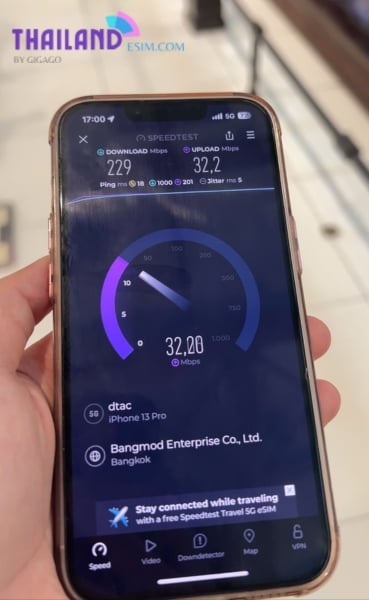
For nomad use cases, the practical verdict: True Move H wins for Bangkok and Chiang Mai city. AIS wins for travel days, island stays, and anywhere outside a major urban center. Yesim’s dual-network access (AIS + True) offers a useful fallback, though it doesn’t automatically combine speeds.
For video calls: 4G at 10+ Mbps upload is comfortable on Zoom, Google Meet, and Teams. All four major networks hit this in Bangkok’s co-working districts. Issues arise in older buildings with poor penetration, and on some islands during peak tourist season when network congestion is real.
Coverage at Top Nomad Destinations
Bangkok — Sukhumvit, Silom, Ari
Excellent 4G/5G coverage across all three networks. Co-working hubs like Hubba, The Hive, and TCDC have strong in-building signal. The BTS/MRT underground stations have patchy coverage but surface areas are consistently good. For nomads, Bangkok is the easiest city in Southeast Asia to stay connected on a mobile connection alone.
Chiang Mai — Nimman & Old City
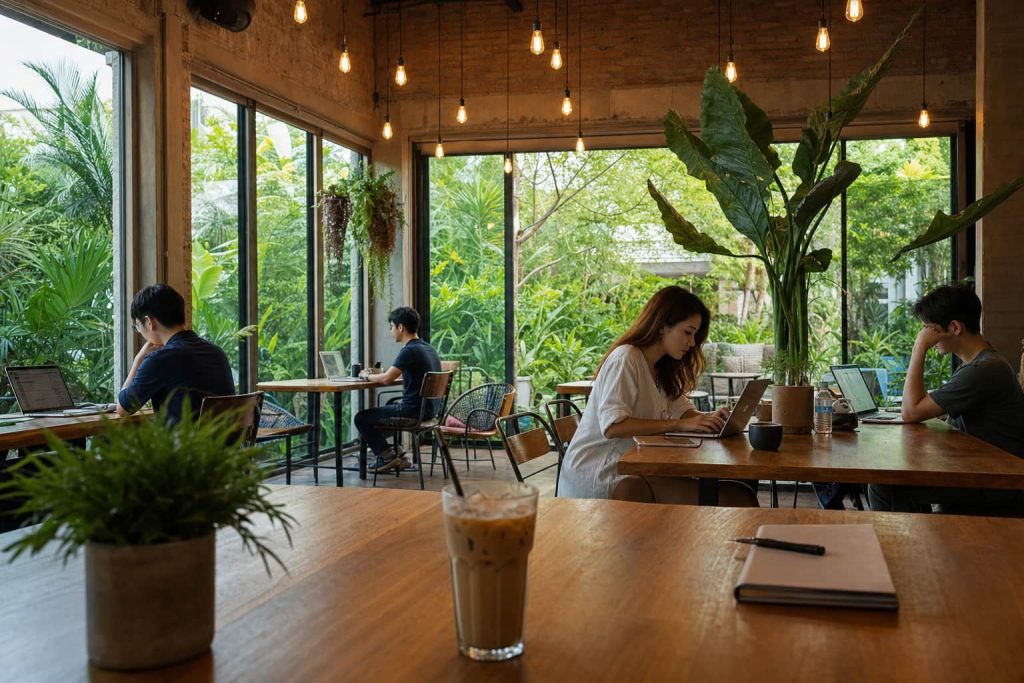
Nimman Road and the surrounding area (MAYA Mall, One Nimman) has reliable 4G on all networks — 15–30 Mbps typical. CAMP at Maya Mall is famous for nomads and sits in a strong coverage zone. The Old City has slightly weaker signal in thick-walled temple areas, but most cafés and co-working spaces are well covered. Speeds are slower than Bangkok but sufficient for remote work: expect 8–20 Mbps upload from most locations.
Koh Lanta & Pai — Rural Coverage Reality
Both are manageable but require lower expectations. Koh Lanta (Long Beach, Saladan) has 4G on AIS and True Move H at the northern end of the island; coverage degrades toward the south and west coast beaches. Pai town center has decent 4G, but the surrounding mountains cause frequent signal drops. If you plan to work seriously from either location, a backup plan (café WiFi) is essential for important calls. Nomads who need guaranteed connectivity should treat these as “light day” destinations and prioritize Bangkok/Chiang Mai for deadline-heavy work.
Hotspot & Tethering — Which Plans Actually Allow It
This is the most commonly misunderstood aspect of travel eSIMs for nomads. “Unlimited” and “hotspot allowed” are two separate questions:
ThailandeSIM.com explicitly allows hotspot on all 7-day+ plans with no separate data cap for tethering. The 30-day unlimited plan at $44.90 covers laptop tethering without restriction. This is the most permissive hotspot policy in this comparison.
Nomad allows hotspot on all plans, including unlimited. The 30-day unlimited at $33 includes full tethering. Note that unlimited plans throttle to 512 kbps after the daily fair-use cap — that speed is usable for email and light browsing on a laptop, but not for video calls or file uploads. Plan accordingly if you’re doing heavy work.
Holafly caps hotspot at 1GB per day across all connected devices. This is a significant limitation for nomads: 1GB disappears quickly when tethering a laptop. Holafly is not recommended as a primary connection for remote workers.
Airalo allows hotspot on most unlimited plans, but conditions vary by specific plan. Check the plan description before purchasing. The 50GB + 100 mins plan at $9.90 for 10 days includes hotspot and is a strong option for shorter nomad stays.
Real-world tethering speeds: When tethered to a laptop, expect 30–50% lower throughput than direct phone speeds due to WiFi conversion overhead. A phone showing 30 Mbps will deliver ~15–20 Mbps to a tethered laptop — more than sufficient for remote work.
eSIM vs Local Thai SIM for Nomads — Cost Over 30 Days

This is the most relevant question for long-stay travelers, and the honest answer is nuanced:
| Option | 30-Day Cost | Data | Where to Buy | Hotspot | Thai Number |
| ThailandeSIM.com eSIM | $44.90 | Truly unlimited | Online (before/after landing) | Yes — unrestricted | Yes (included) |
| Nomad eSIM | $33.00 | Unlimited (FUP throttle) | Online (before/after landing) | Yes | No |
| AIS Tourist SIM | ~$16–$20 | Unlimited (FUP throttle) | Airport or AIS store in Thailand | Yes | Yes |
| True Move H Tourist SIM | ~$19–$25 | Up to 100 GB | Airport or True store in Thailand | Yes | Yes |
Local Thai SIMs are cheaper for 30-day stays — that’s the honest answer. AIS and True Move H both offer tourist SIM packs available at Suvarnabhumi Airport (Level B, Arrivals hall) for around 600–800 THB ($16–$22). The trade-off is physical presence: you need to buy it in Thailand, carry your passport, and queue at the counter on arrival after a long flight.
When eSIM is worth the premium: If you’re arriving on a tight schedule, flying into an airport without a carrier counter (Chiang Mai domestic, smaller regional airports), want to land already connected, or need a plan confirmed before departing home for visa or accommodation purposes — eSIM eliminates friction that’s genuinely costly.
For nomads staying 2+ months, many use an eSIM for the first 30 days, then switch to a local SIM after they’ve had time to visit a carrier store without rush.
Our Pick: Best Thailand eSIM for Digital Nomads
For most nomads, ThailandeSIM.com’s 30-day unlimited plan at $44.90 is the strongest combination of data volume, hotspot freedom, and network reliability. The truly unlimited data (no daily cap, no throttle) means you won’t hit a wall during a large file upload or on a day with heavy video calls. The included Thai phone number is a practical bonus for booking co-working spaces, restaurants, and local services by phone.
If cost is the primary concern: Nomad’s 30-day unlimited at $33 is the best-value option, with the caveat that the 512 kbps throttle after the daily cap will limit your backup tethering sessions to light use only.
For nomads who travel between multiple Southeast Asian countries and need one app: Airalo’s 30-day plan at $49 is competitive and allows easy switching to other country eSIMs without a new provider account.
Frequently Asked Questions
Which Thailand eSIM works best in Chiang Mai?
For Chiang Mai, True Move H and AIS both perform well in the city center (Nimman Road, Old City). ThailandeSIM.com’s plans run on DTAC/True Move H infrastructure, which delivers strong 4G in Chiang Mai’s co-working zones. Nomad uses AIS and DTAC — AIS is the stronger rural option if you plan day trips into the mountains. For strictly urban nomad work in Chiang Mai, any of the top three providers will be reliable.
Can I top up my Thailand eSIM if I run out of data?
It depends on the provider. Nomad offers direct data add-ons purchasable via their app — these activate immediately without changing your existing eSIM. Airalo allows renewals and additional data packs. ThailandeSIM.com recommends purchasing a new plan when the current one expires; their WhatsApp support team (Thai timezone) can assist with fast activation. Holafly top-ups are available through their customer centre. If you’re on a 30-day unlimited plan, running out entirely is unlikely under normal remote-work usage.
Does any Thailand eSIM support 5G?
Yes. ThailandeSIM.com uses DTAC/True Move H’s 5G network, which covers central Bangkok, Sukhumvit, Silom, Chatuchak, and parts of Chiang Mai city. Airalo’s True Move H plans also include 5G in covered zones. AIS (used by Nomad) has 5G deployment in Bangkok but with slightly lower geographic spread than True Move H. In practice, 5G availability depends heavily on your physical location — most nomad co-working areas in Bangkok will see 5G signal on True-network plans.
Is it better to buy a local Thai SIM or use an eSIM for a month?
For pure cost, a local Thai SIM from AIS or True Move H is cheaper ($16–$22 for 30 days). The trade-off is that you must buy it in-person in Thailand with your passport, which means queueing at the airport or visiting a carrier store. An eSIM like ThailandeSIM.com costs more ($44.90) but can be purchased from home, activates before landing, and includes a Thai phone number without store visit. Most nomads on a first Thailand stay choose eSIM for the landing-day convenience, then reassess for subsequent visits.
Long stays in Thailand are easier with the right data plan. ThailandeSIM.com’s 30-day unlimited gives nomads the data volume, hotspot freedom, and network reliability to work from anywhere — Bangkok rooftop to Chiang Mai café.